
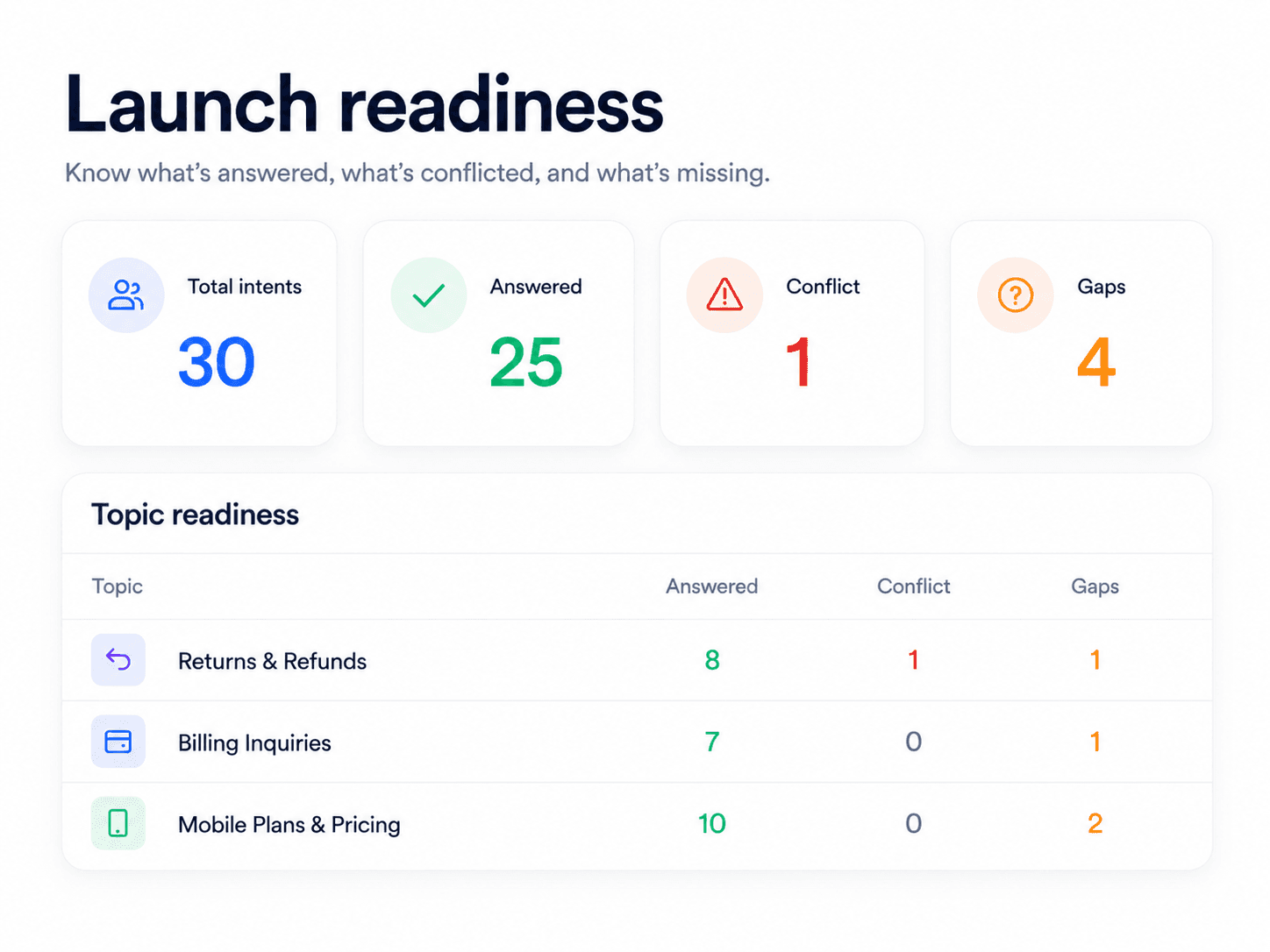
Audit template
Chatbot Knowledge Base Audit Template: Copy, Grade, and Launch
An audit-report template for grading and exporting a chatbot knowledge base audit with launch scope decisions and source-fix backlog.
Support Readiness Lead, Meihaku · May 11, 2026
A chatbot knowledge base audit template should be copyable, gradable, and exportable. It should turn a documentation review into a launch decision with score bands, approved scope, blocked intents, conflict tables, and a source-fix backlog.
This template combines sample-report, scanner, and article-gap workflows for Meihaku's source-readiness layer: audit support knowledge before the chatbot answers customers.
Copy the template below into your launch review, grade each dimension, and export the result as a shared launch artifact.
What this helps decide
Turn Chatbot Knowledge Base Audit into launch scope.
Use this guide to decide which customer intents are approved for AI, which need restrictions, which need source cleanup, and which should stay human-owned.
Evidence used
Sources, policies, and support artifacts
- AI readiness score
- Help.center: AI knowledge support article
- HappySupport: knowledge base AI readiness audit
Review output
Approve, restrict, block, or hand off
- Template setup
- Grading
- Export and action
How this guide was built
3 public references, 8 review areas
- Audit header and scope
- Dimension 1: coverage score
- Dimension 2: freshness score
Audit header and scope
Start every audit with a header that names the chatbot, the source systems reviewed, the number of customer intents audited, the date, the reviewer, and the next review trigger. This makes the audit a living document rather than a one-time check.
Scope the audit to the intents the chatbot will answer first. Do not try to audit every article in the knowledge base. Focus on the top launch intents and the highest-risk exceptions.
- Chatbot or AI agent name and platform.
- Source systems: help center, macros, SOPs, policies, tickets, files.
- Number of customer intents reviewed.
- Reviewer name, date, and next review trigger.
Dimension 1: coverage score
Coverage measures whether each top customer intent has a focused, current source. Score coverage by intent, not by article count. A knowledge base with 500 articles but no answer for the top refund question scores low.
Score bands: 0-39 missing critical coverage; 40-59 partial coverage with gaps; 60-79 strong coverage with minor gaps; 80-100 complete coverage for launch intents.
- Map top 25 to 50 customer intents to sources.
- Flag missing sources as blocked.
- Flag broad or combined articles as restricted.
- Add missing coverage to the source-fix backlog.
Dimension 2: freshness score
Freshness measures whether sources were reviewed after the latest product, pricing, policy, or workflow change. An article can be old but fresh if it was verified recently. An article can be new but stale if it skipped the latest update.
Weight high-risk topics higher. A stale article about return policy is more dangerous than a stale article about company history.
- Record last-reviewed date for each launch intent.
- Compare review dates to last product and policy changes.
- Weight refund, billing, privacy, account, and compliance topics higher.
- Mark stale high-risk sources as source-fix-needed.
Dimension 3: conflict score
Conflict measures whether help articles, macros, SOPs, and policies agree. The AI can retrieve multiple sources and blend them. If they contradict, the chatbot may produce a confident wrong answer.
Score conflict by intent. One clear canonical source scores high. Two or more conflicting sources score low and should block the intent until resolved.
- Map each intent to all sources that mention it.
- Flag contradictions between public and private sources.
- Require a canonical source owner to resolve each conflict.
- Block conflicting intents until retested after resolution.
Dimension 4: escalation clarity score
Escalation clarity measures whether sources tell the chatbot when to stop and hand off. Articles that say contact support without specifying why are weak. Articles that name the exact conditions requiring human review are strong.
Escalation is not failure. It is the correct behavior for complaints, legal threats, privacy requests, security issues, regulated advice, account changes, and high-cost exceptions.
- Name the conditions that require human escalation.
- Distinguish self-service from agent-required paths.
- Link to handoff rules or escalation workflows.
- Treat unclear escalation as a launch restriction.
Launch scope and score bands
The audit should produce a launch recommendation based on the overall score. Use score bands to decide whether the chatbot is ready for broad automation, narrow pilot, or source-fix first.
Export the launch scope as a shared artifact: approved intents, restricted intents, blocked intents, source-fix-needed intents, and human-only intents. This becomes the configuration boundary for the chatbot platform.
- 0-39: do not launch; fix sources first.
- 40-59: pilot low-risk intents with tight review.
- 60-79: expand approved intents while measuring failures.
- 80-100: maintain governance and retest after changes.
Source-fix backlog and retest plan
Every blocked or source-fix-needed intent should become a work item. The backlog should include the exact source to fix, the owner, the deadline, the customer-safe wording, and the retest prompt. Sort by launch impact.
The retest plan should specify which customer phrasing to rerun after each fix. Without retest prompts, teams often fix the source but forget to verify that the chatbot now answers correctly.
- Link each backlog item to the customer intent it unlocks.
- Assign owners and deadlines.
- Include customer-safe canonical wording.
- Attach the retest prompt that proves the fix.
- Schedule retest after every source or policy change.
Export and share the audit report
The final audit should be exportable as a report that support ops, legal, compliance, product, and vendor admins can all read and act on. Include the score bands, launch scope, conflict table, source-fix backlog, retest plan, and reviewer signatures.
The report becomes the compliance record, the launch boundary, and the post-launch monitoring baseline. Update it when sources change, wrong answers appear, or the chatbot scope expands.
- Export score band and launch recommendation.
- Include intent-level grades and missing coverage list.
- Attach conflict table with source owners and deadlines.
- Add source-fix backlog sorted by launch impact.
- Include retest prompts and monitoring metrics.
Checklist
Use this as the working review before launch.
Template setup
- Name chatbot, sources, reviewer, date, and next review trigger.
- List top launch intents and high-risk exceptions.
- Map each intent to help center, macro, SOP, and policy sources.
- Separate customer-safe sources from internal-only guidance.
Grading
- Score coverage, freshness, conflict, and escalation clarity.
- Record blocked intents with exact missing or conflicting source.
- Mark restricted intents with the condition that makes them safe.
- Attach reviewer decisions to each launch-scope change.
Export and action
- Export launch scope as approved, restricted, blocked, source-fix, and human-only.
- Create source-fix backlog with owners, deadlines, and retest prompts.
- Share report with support ops, legal, compliance, and vendor admins.
- Schedule retest after source, policy, product, or vendor changes.
How Meihaku helps
Turn the checklist into a launch audit.
Meihaku reads your sources, maps them to customer intents, drafts cited answers, and shows which topics are cleared for AI, blocked, source-fix needed, or human-only.
Related guides
Keep clearing answers before launch.
These pages connect testing, knowledge-base cleanup, and readiness scoring into one pre-launch workflow.
Zendesk AI readiness
Zendesk AI Readiness Audit
Audit Zendesk Guide, macros, ticket history, and policy documents before Zendesk AI answers customers.
Vendor pageIntercom Fin readiness
Intercom Fin Readiness Audit
Audit your Intercom Fin rollout before customers see it. See which intents are cleared for Fin, which need source cleanup, and which should stay human-only.
Vendor pageGorgias AI readiness
Gorgias AI Readiness Audit
Audit your Gorgias AI rollout before it handles refund, order, shipping, and product questions.
Vendor pageFreshdesk AI readiness
Freshdesk Freddy AI readiness audit
Use this readiness workflow to check whether Freshdesk solution articles, ticket patterns, Freddy AI Agent knowledge sources, and workflows can safely support AI answers.
Vendor pageSalesforce AI readiness
Salesforce Service Cloud AI readiness audit
Use this readiness workflow to check whether Salesforce Knowledge, Service Cloud cases, Agentforce actions, and support policies are safe for customer-facing AI.
Vendor pageHubSpot Customer Agent readiness
HubSpot Customer Agent readiness audit
Use this readiness workflow to check whether HubSpot content, public URLs, tickets, and Service Hub knowledge are ready to ground Breeze-powered customer agent answers.
Vendor pageHelp Scout AI readiness
Help Scout AI readiness audit
Use this readiness workflow to check whether Help Scout Docs, AI Answers knowledge sources, Beacon flows, and support conversations are safe for customer-facing AI.
Vendor pageKustomer AI readiness
Kustomer AI readiness audit
Use this readiness workflow to check whether Kustomer knowledge, CRM context, customer history, and AI Agent workflows can safely support autonomous CX answers.
Vendor pageGoogle Docs readiness
Meihaku for Google Docs
Use Meihaku to audit support policies, SOPs, macros, and FAQ documents stored in Google Drive before an AI support agent relies on them.
Vendor pageNotion readiness
Notion support knowledge readiness audit
Use this readiness workflow when support policies, SOPs, FAQs, release notes, and escalation guidance live in Notion before AI support launch.
Vendor pageConfluence readiness
Confluence support knowledge readiness audit
Use this readiness workflow when support policies, troubleshooting articles, SOPs, and internal knowledge base spaces live in Confluence.
Vendor pageAI support readiness template
AI support launch checklist
A vendor-neutral CSV checklist for deciding which customer intents are approved, restricted, blocked, or human-only before an AI support agent goes live.
TemplateAI agent testing template
AI agent testing framework
A vendor-neutral CSV template for testing customer-facing AI agents by intent, source evidence, policy fit, escalation behavior, reviewer workflow, and launch state.
TemplateAI support risk template
AI support risk register
A CSV risk register for support teams deciding which insurance, telehealth, ecommerce, and cross-industry customer intents can safely be automated.
TemplateZendesk AI checklist
Zendesk macro audit
A checklist for turning Zendesk Guide, shared macros, ticket patterns, and internal policies into approved, restricted, blocked, and source-fix decisions.
TemplateGorgias AI checklist
Gorgias ecommerce checklist
A practical ecommerce test matrix for deciding which Gorgias AI intents are approved to answer and which need better guidance, source evidence, or human handoff.
TemplateKnowledge-base audit
Knowledge Base AI Readiness Audit
A step-by-step AI knowledge base audit for finding stale articles, policy conflicts, missing intents, weak citations, and unsafe automation scope.
ReadDocumentation checklist
AI-Ready Documentation Checklist
A documentation checklist to audit help docs, macros, SOPs, and policies for decay, conflict, and safe AI launch scope.
ReadHelp center scorecard
Help Center Readiness Scorecard
A scanner scorecard to grade help center pages for AI readiness across coverage, decay, conflict, and safe automation scope.
ReadPolicy conflict audit
Macro vs Help Center Audit
A policy conflict audit to compare macros, help docs, and SOPs and find contradictions that become AI wrong answers.
ReadDocumentation decay
Documentation Decay
A documentation decay guide for AI support launches, focused on stale sources, policy drift, translation lag, macro conflicts, and safe automation scope.
ReadSample report
AI Support Readiness Sample Report
A sample report page for Meihaku: concrete support risk categories, launch states, source fixes, owners, and retest steps.
ReadAI support readiness score
AI Support Readiness Score Methodology
A practical scoring method for support teams deciding whether their knowledge base, policies, tests, and handoff rules are ready for customer-facing AI.
ReadAI support risk register
AI Support Risk Register
A support-specific guide to using a risk register before AI agents answer insurance, telehealth, ecommerce, and other sensitive customer questions.
ReadFAQ
Common questions
What is a chatbot knowledge base audit template?
It is a copyable, gradable framework for auditing whether a chatbot's knowledge sources are current, consistent, customer-safe, and scoped before launch. It produces score bands, launch scope, conflict tables, and a source-fix backlog.
How is this different from a model eval report?
A model eval report scores chatbot outputs. A knowledge base audit template scores whether the support operation has enough evidence to let the chatbot answer each customer intent safely.
Who should use this template?
Support ops, CX leaders, knowledge owners, legal or compliance reviewers, product managers, and vendor admins can all use the template to agree on launch scope before the chatbot goes live.
How does Meihaku help with the audit?
Meihaku maps customer intents to source evidence, grades coverage, freshness, conflict, and escalation clarity, and exports the audit as a shareable report with launch scope and source-fix backlog.
Sources
Vendor documentation and public references that ground the claims in this guide.