Documentation decay
Support Documentation Decay and AI Readiness
A documentation decay guide for AI support launches, focused on stale sources, policy drift, translation lag, macro conflicts, and safe automation scope.
Support Readiness Lead, Meihaku · May 11, 2026
Documentation decay is what happens when support knowledge stops matching the product, policy, or real customer workflow. Humans often work around it with memory. AI agents turn it into confident wrong answers.
The core documentation-readiness insight is right: chatbot quality is limited by documentation quality. Meihaku makes that operational by asking which decayed sources should block AI launch scope.
Use this guide to find stale help articles, outdated macros, SOP drift, screenshot mismatch, translation lag, and policy contradictions before an AI support agent uses them.
What this helps decide
Turn Documentation Decay into launch scope.
Use this guide to decide which customer intents are approved for AI, which need restrictions, which need source cleanup, and which should stay human-owned.
Evidence used
Sources, policies, and support artifacts
- HappySupport: knowledge base AI readiness audit
- HappySupport blog
- Zendesk: preparing your help center for generative AI
Review output
Approve, restrict, block, or hand off
- Find decay
- Score launch risk
- Fix and retest
How this guide was built
4 public references, 5 review areas
- Stale help articles become stale AI answers
- Macros decay faster than help centers
- SOP drift creates hidden exceptions
Stale help articles become stale AI answers
A help article can look polished and still be unsafe for AI. Old plan names, retired pricing, outdated screenshots, missing eligibility windows, and old escalation paths all become source evidence when an AI agent retrieves the page.
The audit should compare every high-volume launch intent against the last product, pricing, policy, and workflow change. If the article was not reviewed after the change, the intent should stay restricted or source-fix-needed.
- Old plan names and prices.
- Screenshots from retired interfaces.
- Policy windows that changed after the article was published.
- Articles with no owner or last-reviewed date.
Macros decay faster than help centers
Macros often change faster than public docs because agents need immediate wording for live customer issues. That makes macros useful evidence, but also a major conflict source.
Compare macros against help articles and SOPs before approving AI answers. If the macro promises a refund, credit, escalation, or workaround that the public policy does not support, the AI should not blend those sources.
- Refund and credit macros.
- Cancellation and downgrade macros.
- Account recovery and security macros.
- Temporary incident or outage macros that became stale.
SOP drift creates hidden exceptions
Private SOPs often contain the real support workflow: when to escalate, who can approve an exception, which customer tier gets a workaround, and which cases need legal or compliance review.
AI readiness requires deciding which SOP instructions are customer-safe and which are internal-only. If the SOP is the only source for a critical exception, the customer-facing answer needs approval before the AI uses it.
- Manager approval rules.
- VIP or enterprise exceptions.
- Fraud, privacy, and account-control workflows.
- Internal-only notes that should never be shown to customers.
Translation lag is a launch blocker
Multilingual help centers decay unevenly. The English article may be current while the Spanish, French, German, or Japanese version still describes the old policy.
If the AI support agent answers in multiple languages, translated sources need their own review state. Do not clear a multilingual intent just because the primary-language page is accurate.
- Compare translated article dates against the canonical source.
- Flag languages where policy-critical pages lag behind.
- Restrict multilingual AI answers until translations are updated.
- Retest customer phrasing in each supported language.
Turn documentation decay into launch decisions
The point of a documentation decay audit is not to clean every page. It is to decide what AI can safely answer in the first launch scope.
Low-risk stale pages can become backlog. High-risk decayed sources should block or restrict the affected customer intent. The launch boundary should move only after the source owner fixes the evidence and reviewers approve the answer.
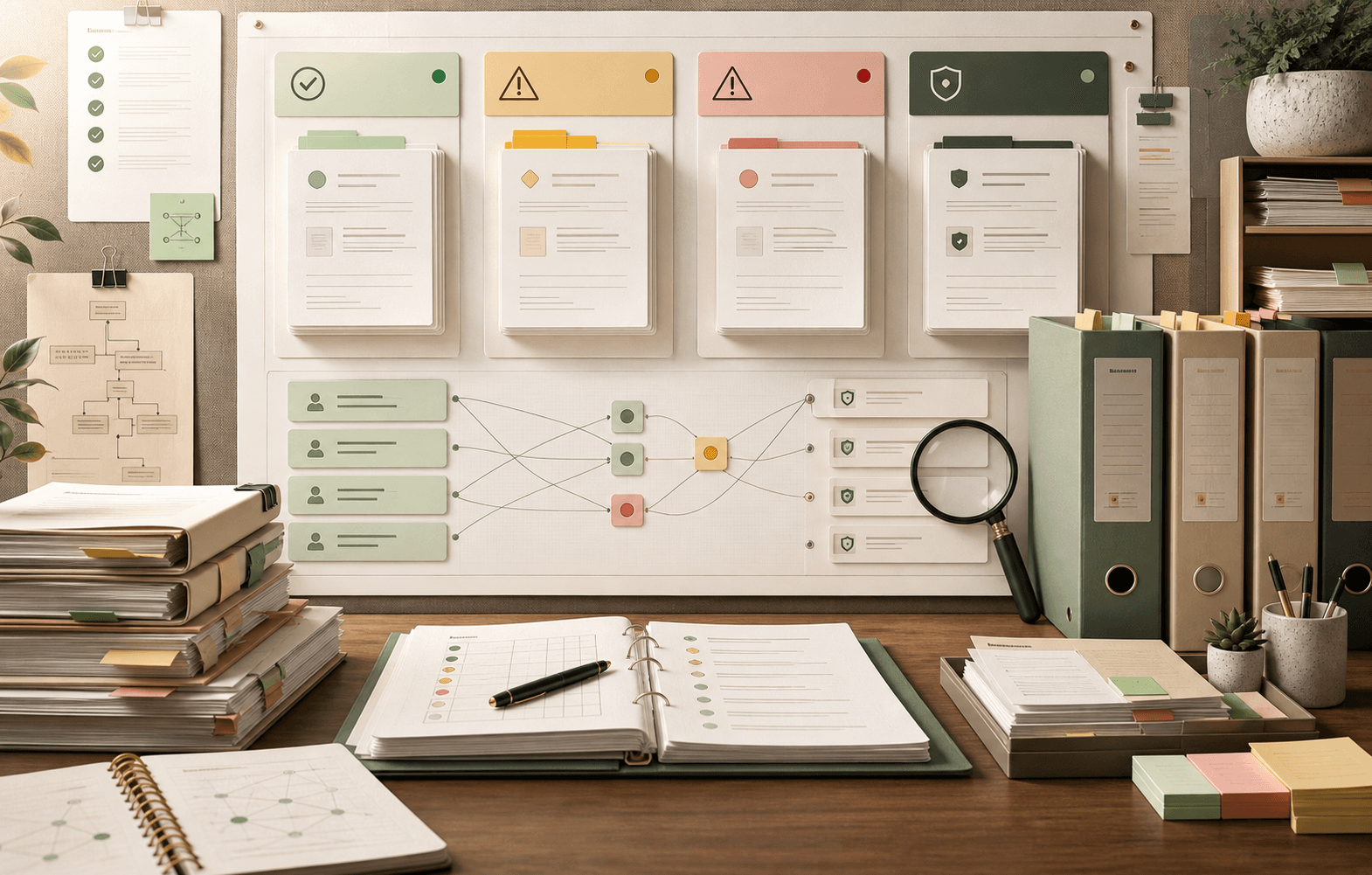
- Approved: source is current and customer-safe.
- Restricted: source works only with extra context.
- Blocked: source is stale, missing, or contradictory.
- Human-only: source requires judgement or private context.
Checklist
Use this as the working review before launch.
Find decay
- List articles changed before the last product, pricing, policy, or workflow update.
- Compare macros against public help-center pages.
- Review SOPs for internal-only exceptions.
- Check translated pages against the canonical article.
Score launch risk
- Map each decayed source to customer intents.
- Prioritize refund, billing, privacy, account, shipping, warranty, and compliance topics.
- Mark each intent approved, restricted, blocked, source-fix, or human-only.
- Assign source owners and review deadlines.
Fix and retest
- Rewrite stale pages with customer-safe conditions.
- Archive duplicate or contradictory sources.
- Update macros and SOPs together.
- Rerun AI prompts after every source fix.
How Meihaku helps
Turn the checklist into a launch audit.
Meihaku reads your sources, maps them to customer intents, drafts cited answers, and shows which topics are cleared for AI, blocked, source-fix needed, or human-only.
Related guides
Keep clearing answers before launch.
These pages connect testing, knowledge-base cleanup, and readiness scoring into one pre-launch workflow.
Google Docs readiness
Meihaku for Google Docs
Use Meihaku to audit support policies, SOPs, macros, and FAQ documents stored in Google Drive before an AI support agent relies on them.
Vendor pageNotion readiness
Notion support knowledge readiness audit
Use this readiness workflow when support policies, SOPs, FAQs, release notes, and escalation guidance live in Notion before AI support launch.
Vendor pageConfluence readiness
Confluence support knowledge readiness audit
Use this readiness workflow when support policies, troubleshooting articles, SOPs, and internal knowledge base spaces live in Confluence.
Vendor pageZendesk AI readiness
Zendesk AI Readiness Audit
Audit Zendesk Guide, macros, ticket history, and policy documents before Zendesk AI answers customers.
Vendor pageIntercom Fin readiness
Intercom Fin Readiness Audit
Audit your Intercom Fin rollout before customers see it. See which intents are cleared for Fin, which need source cleanup, and which should stay human-only.
Vendor pageGorgias AI readiness
Gorgias AI Readiness Audit
Audit your Gorgias AI rollout before it handles refund, order, shipping, and product questions.
Vendor pageAI support readiness template
AI support launch checklist
A vendor-neutral CSV checklist for deciding which customer intents are approved, restricted, blocked, or human-only before an AI support agent goes live.
TemplateZendesk AI checklist
Zendesk macro audit
A checklist for turning Zendesk Guide, shared macros, ticket patterns, and internal policies into approved, restricted, blocked, and source-fix decisions.
TemplateGorgias AI checklist
Gorgias ecommerce checklist
A practical ecommerce test matrix for deciding which Gorgias AI intents are approved to answer and which need better guidance, source evidence, or human handoff.
TemplateKnowledge-base audit
Knowledge Base AI Readiness Audit
A step-by-step AI knowledge base audit for finding stale articles, policy conflicts, missing intents, weak citations, and unsafe automation scope.
ReadAI support readiness score
AI Support Readiness Score Methodology
A practical scoring method for support teams deciding whether their knowledge base, policies, tests, and handoff rules are ready for customer-facing AI.
ReadSample report
AI Support Readiness Sample Report
A sample report page for Meihaku: concrete support risk categories, launch states, source fixes, owners, and retest steps.
ReadAI chatbot testing
AI Chatbot Testing Checklist
A practical chatbot testing checklist for support teams checking accuracy, policy safety, escalation, tone, and re-contact risk before launch.
ReadCustomer service QA
Customer Service QA for AI Support
A practical guide for turning customer service QA into an AI support quality program that reviews source evidence, policy safety, escalation, and re-contact risk.
ReadFAQ
Common questions
What is documentation decay?
Documentation decay is the gap between what support sources say and what the product, policy, workflow, or support team actually does today.
Why does documentation decay matter for AI support?
AI agents often retrieve written sources as operational truth. If the source is stale or contradictory, the AI can turn old documentation into a confident customer-facing mistake.
Should we update the whole knowledge base before launch?
No. Start with the intents the AI will answer first, then fix high-risk and high-volume sources. The launch boundary should stay narrow until the evidence improves.
How does Meihaku find documentation decay?
Meihaku maps customer intents to help articles, macros, SOPs, policies, tickets, and reviewer decisions, then flags stale, missing, conflicting, or internal-only sources before launch.
Sources
Vendor documentation and public references that ground the claims in this guide.