
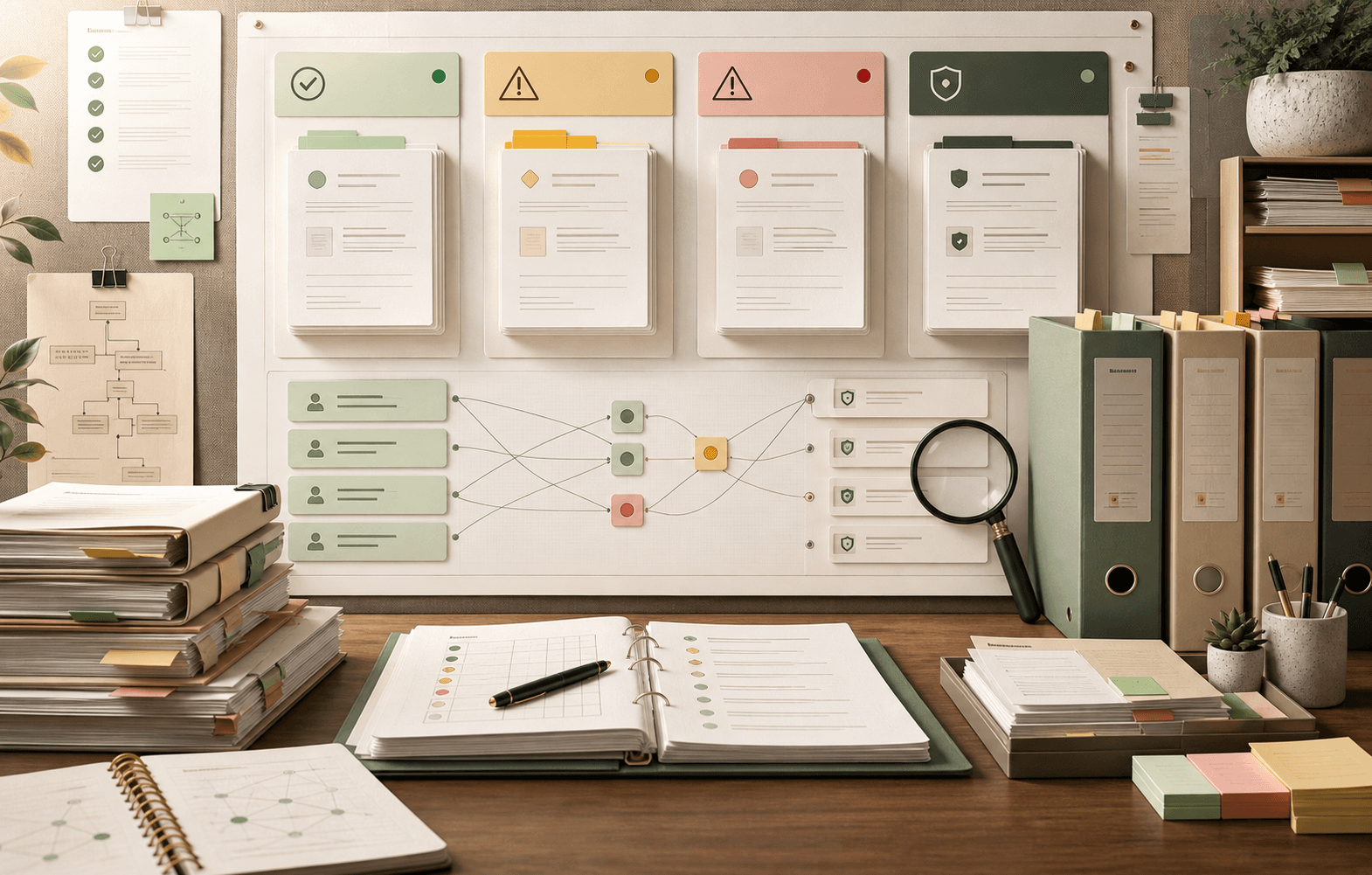
Knowledge-base audit
How to Audit Your Knowledge Base for AI Readiness
A step-by-step AI knowledge base audit for finding stale articles, policy conflicts, missing intents, weak citations, and unsafe automation scope.
Support Readiness Lead, Meihaku · April 22, 2026
A knowledge base that works for human agents may not be ready for AI. Humans use memory, Slack, judgment, and context. AI agents retrieve what is written and treat it as operational truth.
An AI knowledge base audit asks whether each customer intent has one current, complete, source-backed answer that an AI agent can safely use. If the answer is missing, stale, contradictory, or written only for internal agents, the AI should not use it with customers.
The output of a good audit is a launch boundary, not a prettier help center: what your AI agent can answer, what it should restrict, and what it must hand off.
What this helps decide
Turn Knowledge Base AI Readiness Audit into launch scope.
Use this guide to decide which customer intents are approved for AI, which need restrictions, which need source cleanup, and which should stay human-owned.
Evidence used
Sources, policies, and support artifacts
- Zendesk: Best practices for preparing your help center for generative AI
- Intercom: Setting up your knowledge base for Fin
- Gorgias: Guidance for AI Agent
Review output
Approve, restrict, block, or hand off
- Source freshness
- Coverage
- AI readiness
How this guide was built
9 public references, 10 review areas
- Is my knowledge base ready for AI?
- Audit by customer intent
- Find stale and duplicate answers
Is my knowledge base ready for AI?
Your knowledge base is ready for AI when each important customer intent has one current, complete, customer-safe answer with clear conditions and source ownership. Most teams discover they are only partially ready.
A human support agent can work around a stale article by remembering the latest Slack update. An AI support agent cannot reliably do that unless the source material has been updated or the agent has a separate approved rule. The audit makes those hidden dependencies visible.
Treat readiness as a question of evidence. If the AI cannot retrieve the correct source, cite it, and apply the right conditions, the intent is not ready for customer-facing automation.
- One canonical answer per important customer intent.
- Current policy and last-reviewed date.
- Customer-facing language, not internal shorthand.
- Explicit handoff rule for missing or high-risk evidence.
Audit by customer intent
Do not start with article count. A large help center can still miss the twenty questions that create the most support risk. Start with the intents customers actually ask about, then map each intent to source evidence.
Use recent tickets, macros, searches, and failed conversations to build the intent list. Include both high-volume and high-risk topics. A rare security or refund edge case may deserve more attention than a common low-risk how-to question.
- Top support tickets from the last 90 days
- High-risk policies such as refund and cancellation
- Known customer confusion points
- Topics that require manager or legal review
- Questions where agents rely on tribal knowledge
Find stale and duplicate answers
Stale articles are not only old pages. A newer macro can make an older article stale. A pricing update can make a help-center screenshot wrong. A support exception can become tribal knowledge but never reach the canonical docs.
Duplicate answers create retrieval risk. If an old refund page and a new macro both answer the same question differently, the AI may retrieve both or choose the wrong one. The audit should consolidate duplicates into one current source.
Look for old plan names, old prices, old product screenshots, outdated compliance language, old shipping cutoffs, and articles with no named owner.
- Sort articles by last review date.
- Compare macros against public help-center answers.
- Search for old plan names, old prices, and old eligibility windows.
- Flag articles that no owner is accountable for.
Detect policy contradictions
Contradictions are the highest-risk knowledge-base defect for AI support. If the refund window is 30 days in one source and 14 days in another, a human might know which one is current. An AI may synthesize both into a confident answer.
A chatbot knowledge base audit should focus especially on policies that create customer commitments: refunds, credits, cancellation, warranty, shipping, eligibility, account recovery, privacy rights, and service-level promises.
For each contradiction, choose the canonical source, rewrite or archive the stale source, and retest the intent before clearing it for automation.
- Refund, credit, and cancellation rules
- Shipping and return windows
- Plan limits and entitlement rules
- Security and account recovery steps
- Data rights, deletion, and privacy workflows
Prepare your help center for an AI agent
AI support agents need self-contained answers. Avoid burying a condition in one section and the answer in another. Avoid internal shorthand, employee names, and instructions like ask billing unless the customer should actually see that instruction.
The practical goal is to prepare help center for AI agent retrieval without turning every article into machine-only content. Customers should still be able to read the page, but the answer, condition, and exception should be close enough that retrieval does not separate them.
Write articles so a single retrieved chunk can answer a customer question without losing critical context. Keep the condition close to the instruction. Replace vague judgment language with clear escalation rules.
This does not mean rewriting the whole help center first. Start with the intents you want the AI to answer in the first launch scope.
- One customer question per article where possible.
- Conditions and exclusions next to the answer.
- No internal employee names or internal-only notes.
- Explicit handoff instruction for unsupported cases.
Use an AI knowledge base audit tool carefully
An AI knowledge base audit tool should do more than count articles. It should map customer intents to source evidence, detect missing answers, flag conflicts, identify stale content, and show which intents are unsafe for automation.
A support knowledge base audit is different from a general content audit. It is less interested in pageviews and more interested in whether the AI can retrieve a current, approved, customer-safe answer for each support intent.
The tool output should be operational. A support leader needs to know which topics are ready, which are blocked, and what cleanup work will reduce launch risk. A generic score without source evidence will not survive contact with a real ticket queue.
Meihaku is designed around that evidence path: sources, intents, cited drafts, readiness states, and approved answers that can be exported downstream.
- Intent-to-source coverage
- Stale and duplicate source detection
- Policy contradiction risk
- Citation coverage
- Launch blocker list
Use a support-readiness scorecard, not a content-health score
The useful scorecard for AI support is stricter than a normal documentation audit. A page can be well written, searchable, and recently edited while still being unsafe for automation if it omits an exception, contradicts a macro, or has no approved handoff rule.
Score each launch intent against the evidence an AI agent will actually use. The output should name the source fix and the launch decision, not just a documentation grade.
- Freshness: source was reviewed after the last product, pricing, policy, or workflow change.
- Coverage: the customer intent maps to a complete answer, not a partial article.
- Conflict: help center, macro, SOP, ticket habit, and private policy do not disagree.
- Citation: the answer can point to customer-safe evidence and avoid internal-only notes.
- Handoff: the intent has a written rule for blocked, restricted, or account-specific cases.
Look beyond one audit: build an operating review system
A serious AI-ready documentation workflow should not stop at one article or one score. It needs guides, templates, scorecards, methodology, article-gap workflows, and exportable reports that keep the audit actionable.
A support knowledge audit should stay specific to launch readiness rather than becoming generic documentation software. The useful output is still a launch boundary: which intents are approved, which sources are stale, which policies conflict, which answers need owner review, and which topics must stay human-owned.
- Use practical scorecards and tiered fix plans rather than abstract advice.
- Make reports copyable or exportable so support teams can turn the audit into work.
- Publish methodology, not just marketing claims, so reviewers can trust the score.
- Connect article gaps to real ticket demand instead of guessing what docs to write next.
- Keep the final decision in launch-scope language: approved, restricted, blocked, or human-only.
The document-audit tool landscape
If the buyer thinks the problem is document audit rather than agent testing, the relevant landscape changes. The alternatives are support-intelligence tools that find documentation gaps, AI knowledge-base products that generate or improve help articles, public-page AI-readiness scanners, and consultants that audit manuals or process documents before AI use.
Conversation-intelligence products analyze support conversations and suggest or refresh help docs. AI knowledge-base products combine a knowledge base, AI search, chatbot, and gap suggestions. AI-ready documentation guides focus on structure, freshness, accuracy, and chatbot retrieval. Public-page readiness scanners audit webpages for AI discoverability and machine readability, which is useful for marketing content but not enough for private support-answer safety. Document-audit services in vertical domains audit operational manuals first, then decide whether an AI support tool is safe to build.
Meihaku's document-audit angle should therefore stay specific: audit support knowledge against real customer intents, detect source conflicts across docs, tickets, macros, and SOPs, and turn the audit into approved, restricted, blocked, or human-only answer scope.
- Conversation-intelligence tools find repeated questions and documentation gaps.
- AI knowledge-base products help create, import, search, and improve help articles.
- AI-readiness scanners audit public webpages for agent discoverability, not private support evidence.
- Document-audit consultants review manuals, procedures, and controls before AI use.
- Meihaku maps private support sources to customer intents and produces a launch boundary.
Create the AI launch boundary
The output of the audit should be a launch boundary. That boundary says which intents are approved, which have gaps, which have conflicts, which are stale, and which require human approval before an AI agent can answer.
The launch boundary is more useful than a generic knowledge-base score because it connects content quality to customer exposure. It lets the team launch AI on safe topics while keeping high-risk topics behind human review.
- Approved: source-backed and policy-safe.
- Gap: customer intent exists but source evidence is missing.
- Conflict: sources disagree and need a canonical answer.
- Stale: source exists but appears outdated.
- Approval-needed: source exists but needs owner review.
Checklist
Use this as the working review before launch.
Source freshness
- Every top article has a last-reviewed date.
- High-risk topics have named owners.
- Product, pricing, and policy changes trigger review.
- Old screenshots and plan names are removed.
- Duplicate articles are archived or consolidated.
Coverage
- Top support intents map to source evidence.
- No high-volume customer question is source-less.
- Edge cases are documented or marked for handoff.
- Internal-only notes are not exposed to customers.
- Blocked topics are explicit in the launch plan.
AI readiness
- Each answer is self-contained.
- Conditions are close to the answer.
- Conflicting sources are resolved.
- Approved answers are exportable to the AI agent.
- Retesting happens after major policy changes.
How Meihaku helps
Turn the checklist into a launch audit.
Meihaku reads your sources, maps them to customer intents, drafts cited answers, and shows which topics are cleared for AI, blocked, source-fix needed, or human-only.
Related guides
Keep clearing answers before launch.
These pages connect testing, knowledge-base cleanup, and readiness scoring into one pre-launch workflow.
Google Docs readiness
Meihaku for Google Docs
Use Meihaku to audit support policies, SOPs, macros, and FAQ documents stored in Google Drive before an AI support agent relies on them.
Vendor pageNotion readiness
Notion support knowledge readiness audit
Use this readiness workflow when support policies, SOPs, FAQs, release notes, and escalation guidance live in Notion before AI support launch.
Vendor pageConfluence readiness
Confluence support knowledge readiness audit
Use this readiness workflow when support policies, troubleshooting articles, SOPs, and internal knowledge base spaces live in Confluence.
Vendor pageSalesforce AI readiness
Salesforce Service Cloud AI readiness audit
Use this readiness workflow to check whether Salesforce Knowledge, Service Cloud cases, Agentforce actions, and support policies are safe for customer-facing AI.
Vendor pageFreshdesk AI readiness
Freshdesk Freddy AI readiness audit
Use this readiness workflow to check whether Freshdesk solution articles, ticket patterns, Freddy AI Agent knowledge sources, and workflows can safely support AI answers.
Vendor pageHubSpot Customer Agent readiness
HubSpot Customer Agent readiness audit
Use this readiness workflow to check whether HubSpot content, public URLs, tickets, and Service Hub knowledge are ready to ground Breeze-powered customer agent answers.
Vendor pageKustomer AI readiness
Kustomer AI readiness audit
Use this readiness workflow to check whether Kustomer knowledge, CRM context, customer history, and AI Agent workflows can safely support autonomous CX answers.
Vendor pageZendesk AI readiness
Zendesk AI Readiness Audit
Audit Zendesk Guide, macros, ticket history, and policy documents before Zendesk AI answers customers.
Vendor pageIntercom Fin readiness
Intercom Fin Readiness Audit
Audit your Intercom Fin rollout before customers see it. See which intents are cleared for Fin, which need source cleanup, and which should stay human-only.
Vendor pageGorgias AI readiness
Gorgias AI Readiness Audit
Audit your Gorgias AI rollout before it handles refund, order, shipping, and product questions.
Vendor pageHelp Scout AI readiness
Help Scout AI readiness audit
Use this readiness workflow to check whether Help Scout Docs, AI Answers knowledge sources, Beacon flows, and support conversations are safe for customer-facing AI.
Vendor pageFront AI readiness
Front AI readiness audit
Use this readiness workflow to review whether Front knowledge base content and customer conversation history can safely ground AI support answers.
Vendor pageAI support readiness score
AI Support Readiness Score Methodology
A practical scoring method for support teams deciding whether their knowledge base, policies, tests, and handoff rules are ready for customer-facing AI.
ReadAI support hallucinations
AI Support Hallucination Examples
A support-specific breakdown of public AI chatbot failures and the readiness controls that prevent policy invention, unsafe handoffs, and brand-damaging answers.
ReadZendesk AI testing
Zendesk AI Testing Checklist
A Zendesk AI testing checklist and macro-audit workflow for support teams that need to prove Guide coverage, macro alignment, escalation behavior, and post-launch QA before customer exposure.
ReadGorgias AI accuracy
Gorgias AI Accuracy Checklist
An ecommerce support checklist for testing Gorgias AI accuracy across product answers, refund rules, shipping exceptions, Shopify actions, handoffs, and rule conflicts.
ReadCustomer service QA
Customer Service QA for AI Support
A practical guide for turning customer service QA into an AI support quality program that reviews source evidence, policy safety, escalation, and re-contact risk.
ReadAI support compliance
AI Support Compliance Checklist
A practical compliance-readiness checklist for support, legal, security, and risk teams reviewing customer-facing AI support before launch.
ReadAI agent testing
AI Agent Testing for Customer Support
A support-specific AI agent testing checklist for policy coverage, source citations, stale answers, escalation rules, and launch go/no-go decisions.
ReadAI chatbot testing
AI Chatbot Testing Checklist
A practical chatbot testing checklist for support teams checking accuracy, policy safety, escalation, tone, and re-contact risk before launch.
ReadAI support readiness
AI Support Readiness Framework
A practical six-dimension framework for auditing knowledge, policies, testing, handoffs, owners, and metrics before an AI support agent answers customers.
ReadFAQ
Common questions
What is an AI knowledge base audit?
An AI knowledge base audit reviews whether your support knowledge can safely ground AI answers. It checks freshness, coverage, contradictions, source ownership, citation quality, and whether each answer is written clearly enough for machine retrieval.
How do I know if my knowledge base is ready for AI?
It is ready when each important customer intent has one current, complete, approved answer with conditions and source evidence. Conflicting policies or missing source evidence mean the intent should stay blocked.
What should a chatbot knowledge base audit include?
It should include intent coverage, stale content, duplicate articles, policy conflicts, source ownership, citation coverage, internal-only notes, and escalation rules for topics the chatbot should not answer.
Should we rewrite the whole help center before launching AI?
Usually no. Start by auditing the highest-volume and highest-risk intents, then clear only the intents that have strong evidence and safe escalation paths.
Sources
Vendor documentation and public references that ground the claims in this guide.
- Zendesk: Best practices for preparing your help center for generative AI
- Intercom: Setting up your knowledge base for Fin
- Gorgias: Guidance for AI Agent
- Help.center: AI knowledge base and chatbot
- Public-page AI agent readiness checker
- HappySupport: knowledge base AI readiness audit
- HappySupport Blog: AI-ready documentation and documentation decay
- AI SEO audit methodology
- Help.center Support: how AI knowledge works