
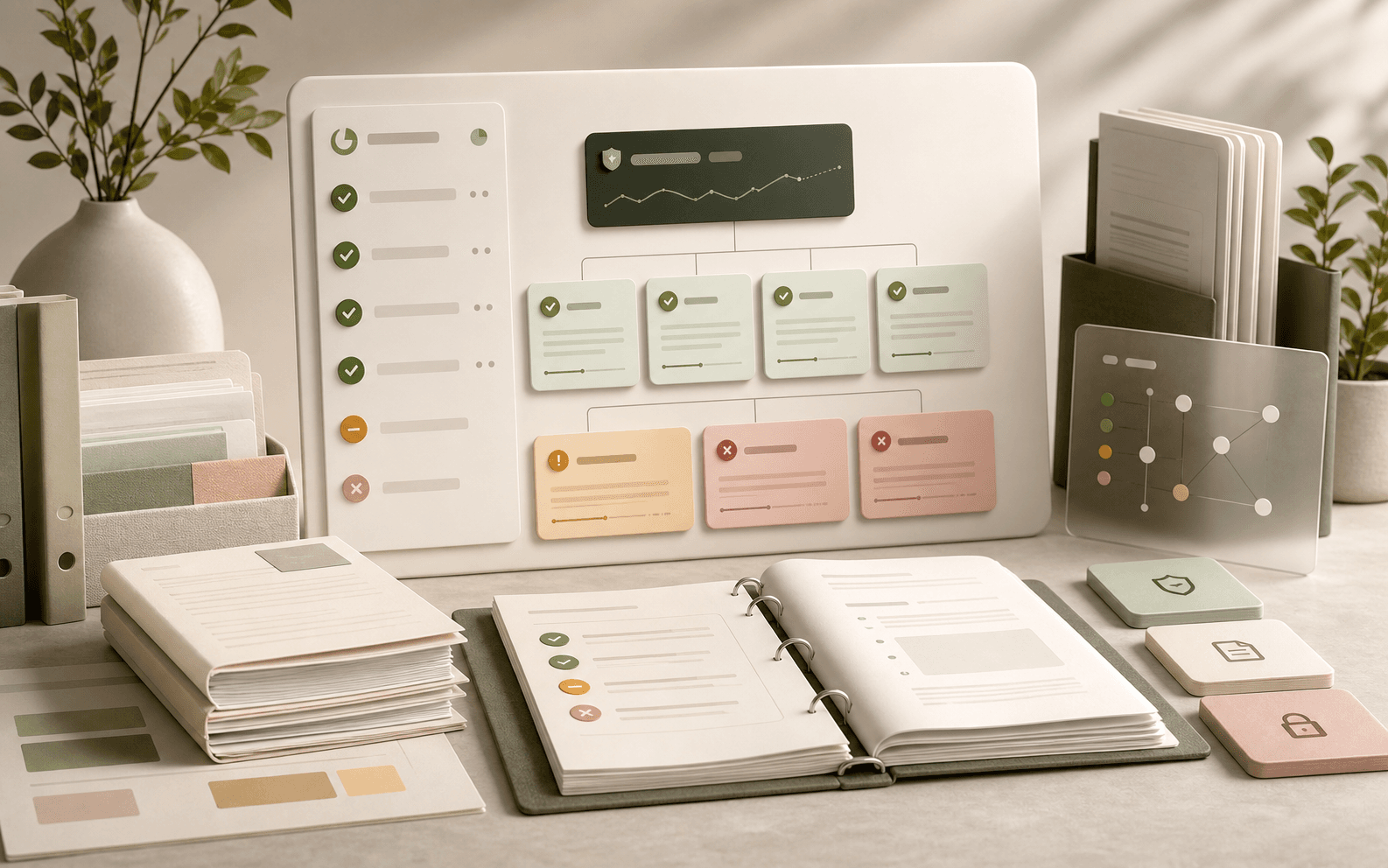
AI support readiness score
AI Support Readiness Score: How to Grade Launch Risk
A practical scoring method for support teams deciding whether their knowledge base, policies, tests, and handoff rules are ready for customer-facing AI.
Support Readiness Lead, Meihaku · May 9, 2026
An AI support readiness score should not be a confidence quiz. It should be a launch-risk score: how much evidence does the team have that the AI can answer real customers without inventing policy, exposing internal notes, or missing escalation?
The useful score is not one number for the whole company. It is a way to decide scope by customer intent: what can be approved, what needs restriction, what is blocked by source cleanup, and what should stay human-owned.
Use this methodology with the AI Support Readiness Score tool, vendor test CSVs, and recent support tickets before expanding Intercom Fin, Zendesk AI, Salesforce Agentforce, Freshdesk Freddy AI, Gorgias AI, HubSpot Customer Agent, Kustomer AI, or a custom support agent.
Score launch risk, not demo quality
Most demos over-score readiness because they ask polished questions against the cleanest help-center content. Customers do not behave that way. They ask with missing context, old product names, policy exceptions, billing edge cases, security concerns, and emotional language.
A readiness score should start from the sources and workflows that will actually constrain the AI. If the answer is not written down, if two sources disagree, or if the handoff rule is informal, the score should stay low even when the model sounds fluent.
- Use recent tickets and conversations, not only invented prompts.
- Attach one source of truth to each answerable intent.
- Treat policy conflicts as launch blockers.
- Score by intent before rolling up to a team-level score.
The six dimensions behind the score
The Meihaku score uses six operational dimensions because AI support failures rarely come from one weak prompt. They usually come from several weak controls at once: stale knowledge, conflicting policy, shallow tests, vague escalation, no source owner, and no post-launch wrong-answer review.
Each dimension should be scored from evidence. A support leader should be able to point to the article, macro, SOP, ticket sample, test run, reviewer decision, or metric that justifies the score.
- Knowledge freshness: articles, macros, SOPs, and internal notes are current.
- Policy conflicts: repeated customer intents do not have contradictory source answers.
- Test evidence: real and high-risk customer phrasing has been tested before launch.
- Escalation: human-only topics and restricted cases have explicit handoff rules.
- Governance: owners, review cadence, and approval records are visible.
- Wrong-answer measurement: post-launch failures can be found, reviewed, and fixed.
How to grade an individual customer intent
A customer intent is ready when the team can prove four things: the question is in scope, the source is current, the answer includes the conditions that matter, and the AI knows when to stop. If any of those are missing, the intent should be restricted, blocked, or human-owned.
This is stricter than generic chatbot testing, but it matches the risk of customer-facing support. A refund answer, account access answer, security answer, or regulated complaint does not become safe because it is well written.
- Approved: source-backed, low-risk, tested, and clear on escalation.
- Restricted: answerable only with segment, eligibility, or context checks.
- Blocked: missing source, stale source, or source conflict.
- Human-only: judgment, legal, security, regulated, or account-control exposure.
How to interpret score bands
A low score does not mean the AI project should stop. It means the launch boundary should shrink. Start with the intents that have current source evidence, clear conditions, and low exception risk, then use the blocked-intent list as the knowledge cleanup backlog.
A high score does not mean every support question should be automated. It means the team has enough evidence to expand in the approved zones while keeping restricted and human-only topics out of the AI's final answer path.
- 0-39: do not launch broad automation; fix sources first.
- 40-59: pilot only low-risk intents with tight review.
- 60-79: expand approved intents while measuring failures.
- 80-100: maintain governance and retest after policy changes.
What to do after scoring
The output should be a working launch map, not a slide. Every score review should create a list of approved intents, restricted intents, blocked intents, source fixes, and human-only topics. That map can then guide vendor configuration, test sets, QA sampling, and post-launch monitoring.
When the score changes, the source evidence should change too. A score increase without updated articles, resolved conflicts, tested edge cases, or clearer handoff rules is usually optimism, not readiness.
- Create a source-fix backlog from blocked and stale intents.
- Retest after every major policy, pricing, or product change.
- Use approved intents as the first AI launch scope.
- Keep a review record for compliance, QA, and support leadership.
Checklist
Use this as the working review before launch.
Before scoring
- Export recent support questions or gather representative ticket samples.
- List the help center, macro, SOP, and policy sources the AI may use.
- Separate customer-facing sources from internal-only guidance.
- Identify sensitive topics that should start human-owned.
During scoring
- Score each dimension from evidence, not opinion.
- Record blocked intents with the exact missing or conflicting source.
- Mark restricted intents with the condition that makes them safe.
- Attach reviewer decisions to each launch-scope change.
After scoring
- Move approved intents into the first launch boundary.
- Turn source gaps into a knowledge-base cleanup backlog.
- Retest the same scenarios after source fixes.
- Track wrong-answer, escalation, re-contact, and override signals after launch.
How Meihaku helps
Turn the checklist into a launch map.
Meihaku reads your sources, maps them to customer intents, drafts cited answers, and shows which topics are ready, stale, conflicting, or blocked.
Related guides
Keep building the launch boundary.
These pages connect testing, knowledge-base cleanup, and readiness scoring into one pre-launch workflow.
Intercom Fin readiness
Meihaku for Intercom Fin
Use Meihaku before and alongside Intercom Fin to decide which customer intents are safe to automate, which need source cleanup, and which should stay human-only.
Vendor pageZendesk AI readiness
Meihaku for Zendesk AI
Use Meihaku to audit whether Zendesk Guide, macros, ticket history, and policy documents are ready for Zendesk AI to answer customers.
Vendor pageSalesforce AI readiness
Salesforce Service Cloud AI readiness audit
Use this readiness workflow to check whether Salesforce Knowledge, Service Cloud cases, Agentforce actions, and support policies are safe for customer-facing AI.
Vendor pageFreshdesk AI readiness
Freshdesk Freddy AI readiness audit
Use this readiness workflow to check whether Freshdesk solution articles, ticket patterns, Freddy AI Agent knowledge sources, and workflows can safely support AI answers.
Vendor pageHubSpot Customer Agent readiness
HubSpot Customer Agent readiness audit
Use this readiness workflow to check whether HubSpot content, public URLs, tickets, and Service Hub knowledge are ready to ground Breeze-powered customer agent answers.
Vendor pageKustomer AI readiness
Kustomer AI readiness audit
Use this readiness workflow to check whether Kustomer knowledge, CRM context, customer history, and AI Agent workflows can safely support autonomous CX answers.
Vendor pageGorgias AI readiness
Meihaku for Gorgias AI
Use Meihaku to check whether ecommerce support knowledge is ready for Gorgias AI before it handles refund, order, shipping, and product questions.
Vendor pageGoogle Docs readiness
Meihaku for Google Docs
Use Meihaku to audit support policies, SOPs, macros, and FAQ documents stored in Google Drive before an AI support agent relies on them.
Vendor pageAI support readiness template
AI support launch checklist
A vendor-neutral CSV checklist for deciding which customer intents are approved, restricted, blocked, or human-only before an AI support agent goes live.
TemplateIntercom Fin testing template
Fin batch test CSV
A launch-ready question set for Intercom Fin Batch Test. Upload the question column, then grade each response against source fit, missing policy detail, and safe escalation.
TemplateZendesk AI checklist
Zendesk macro audit
A checklist for auditing Zendesk Guide, shared macros, ticket patterns, and internal policies before using AI suggestions or customer-facing automation.
TemplateGorgias AI checklist
Gorgias ecommerce checklist
A practical ecommerce test matrix for deciding which Gorgias AI intents are safe to automate and which need better guidance, source evidence, or human handoff.
TemplateAI agent testing framework
AI Agent Testing Framework
A practical framework for testing customer-facing AI support agents by intent, source evidence, policy fit, escalation behavior, and launch state.
ReadAI support readiness
AI Support Readiness Framework
A practical six-dimension framework for auditing knowledge, policies, testing, handoffs, owners, and metrics before an AI support agent answers customers.
ReadKnowledge-base audit
Knowledge Base AI Readiness Audit
A step-by-step AI knowledge base audit for finding stale articles, policy conflicts, missing intents, weak citations, and unsafe automation scope.
ReadAI agent testing tools
AI Agent Testing Tools
A buyer-focused guide to choosing AI agent testing tools for customer support teams preparing Intercom Fin, Zendesk AI, Gorgias AI, Agentforce, or custom agents.
ReadAI agent testing
AI Agent Testing for Customer Support
A support-specific AI agent testing checklist for policy coverage, source citations, stale answers, escalation rules, and launch go/no-go decisions.
ReadCustomer service QA
Customer Service QA for AI Support
A practical guide for turning customer service QA into an AI support quality program that reviews source evidence, policy safety, escalation, and re-contact risk.
ReadAI support compliance
AI Support Compliance Checklist
A practical compliance-readiness checklist for support, legal, security, and risk teams reviewing customer-facing AI support before launch.
ReadAI support hallucinations
AI Support Hallucination Examples
A support-specific breakdown of public AI chatbot failures and the readiness controls that prevent policy invention, unsafe handoffs, and brand-damaging answers.
ReadFAQ
Common questions
What is an AI support readiness score?
It is a launch-risk score that measures whether support knowledge, policies, tests, escalation rules, governance, and wrong-answer measurement are ready for customer-facing AI support.
What is a good AI support readiness score?
A good score depends on launch scope. Scores above 80 are usually strong enough for carefully governed expansion, while lower scores can still support a narrow pilot if risky intents stay blocked or human-owned.
Should readiness be scored by page or by customer intent?
Score by customer intent. A page-level audit can show stale content, but launch decisions need to know which customer questions have source-backed, tested, and safe answers.
Can a high readiness score replace human QA?
No. The score helps choose launch scope. Human QA still needs to review answer quality, source fit, escalations, and wrong-answer patterns after launch.